Free virtual event: hear from influencer leaders at ŌURA, Adobe, Stanley 1913 & more.
See the lineup


Black Friday is one of those chaotic, intense times when you’re getting a ping every 10 minutes, juggling six briefs at once (and they keep multiplying!), managing a gazillion discount codes, and slurping coffee that’s already gotten cold.
We asked 53 influencer marketers the ins and outs of how they plan their BFCM campaigns and what lessons they’ve learned from their previous experiences – so you can turn BFCM’s pure chaos into manageable magic.
We asked marketers a series of questions to understand their overall BFCM timelines for different workflows:

While the responses are definitely varied, the results are similar to last year: on average, marketers start planning BFCM promotions in late July and they have a finalized plan by mid-August. Almost all creators are hired as September inches to a close.
Many marketers also said beginning their BFCM campaigns early is the number one change they’re making this year. Abdullah Khan shared:
The #1 thing we’re changing this year is starting earlier and locking in creators sooner. Last year, we waited a bit too long to finalize some partnerships, and by then, a lot of quality influencers were already booked or raising their rates.

Lucy Serveega also explained why she’s planning on beginning BFCM preparations early this year:
Last year, we didn’t have enough time for preparation, as everything started a bit too late. That’s why I’d like to begin preparing for the Black Friday campaign in August. It would be ideal to communicate with all potential collaborators in advance.

She continues to explain starting BFCM prep early would have:
We can secure their commitments early, gather all necessary information, and complete content creation and planning ahead of time. As a result, tracking, analytics, and logistics – which are often a source of stress – will be much more manageable.
So, when should you start planning for BFCM? Plan 80% of what you’ll do by the end of Q2 and leave the rest for later.
There are exceptions to this timeline, though:
Starting early (especially around September–October) doesn’t just help you prepare better, but also gives you a huge competitive advantage: this is the time consumers are deciding which items they’re going to purchase during Black Friday. A recent survey by Bankrate found 48% of consumers begin shopping before Halloween – out of those, 25% start as early as September.

When you’re on top of mind that early, consumers are already aware of your products and eager to purchase during BFCM. Mark Dandy agrees:
“During that September-October time frame, the brand awareness spend should go up because you want to be front of mind when the discounts kick in as well.”

There’s another major benefit of starting your BFCM prep early: you get influencer content in September and October that you can repurpose in November – whether that’s for ads, email marketing, or your website.
Having influencer content ready to repurpose in October and November is a massive advantage. 63.2% of marketers in our survey said repurposed influencer content outperformed other kinds of content during BFCM.

For Lee Drysdale, influencer content performed exceptionally well in promotional emails:
Our repurposed influencer content generally outperformed our standard brand content in terms of engagement and click-through, especially during BFCM. Posts and ads featuring authentic creator visuals saw higher reach and stronger CTR compared to purely branded creative, especially on BFCM emails!

For Abdullah, the repurposed influencer content outperformed on every channel. He mentions that ads, emails, and their product pages performed better when it included influencer visuals – which felt more authentic and relatable, and led to higher overall engagement and sales. He hits the nail in the head when he explains why influencer content performs better than other – more polished – content:
People trust real voices, and during BFCM when everyone is bombarded with offers, that authenticity really stands out.
The conclusion: start your BFCM planning as early as possible to stay competitive. Here’s what the average BFCM timeline for ecommerce marketers looks like.
.png)
But remember these two caveats:
Ecommerce marketers are prioritizing Instagram during BFCM, followed by TikTok and YouTube.

Which social media platform should you choose for your BFCM campaigns? It depends on various factors:
The best-case is using a mix of short-form and long-form content so you can capitalize on the fast-moving channels, while also being present on evergreen platforms like YouTube.
You can learn more about the strengths and weaknesses of each channel in this TikTok vs. Instagram vs. YouTube guide.
We also asked marketers the exact deliverables they prioritize during BFCM for each platform.

Which deliverables should you ask for? It depends on your overall strategy, goals, and budget.
In the end, the mix you choose (of channels and deliverables) should depend on how your ICP behaves and shops during BFCM to buy products like yours. For high-ticket items, people might scour detailed YouTube reviews before making a purchase. For impulse purchases, they might rely on TikTok and Instagram.
42.7% of marketers in our survey said they promote all the products in their inventory during BFCM.

This is consistent with last year, when over half the marketers (54.2%) said they promote the full inventory during BFCM.
Which option should you choose?
Fiorella Picado picks products based on how social media friendly they are – which is also a great tactic:
[We promote products] according to what's discounted and what's more social media friendly. I like to pick 'hook products' that I know will attract people from socials, lead them to the brand's website, and then let the customer discover the rest.
Paulina Cieslik takes a similar approach, where the entire product catalog has discounts, but the social media promotion is focused on a select few that’ll get people to the website:
The promotion covers the entire product range, but our communication focuses on bestsellers.

If you’re promoting all products in your store, you can also create special BFCM bundles which include your slow-moving products along with the bestsellers. Customers will see it as a steal deal and you’ll hit two birds with one stone.
Nearly everyone (except 9.4% of marketers) in our survey said they increased their budget for BFCM. A majority of the marketers increase their budget by 25–50%.

It makes sense:
We had some great fits in mind for Black Friday campaigns, but the timing and pricing were simply out of scope for what we could allocate at that point. We had to prioritize creators already on our list or go with smaller partnerships instead.
All of the above factors require allocating more budget than usual. Last year, too, 62.5% of marketers said they increased their budget for BFCM.
But how do marketers actually use the extra money in their hands? As you can predict, a majority of the additional budget is spent on hiring more influencers or collaborating with bigger influencers.

Like before, if you want to cut some costs here, get the first-mover advantage and book your creators early. Victor Wiśniowski agrees:
We always tell our clients that if they really want to lock in their Black Friday campaigns, they should start early to make sure that they get all the influencers that they want.

If you have been building long-term relationships with a handful of creators, they’re also more likely to collaborate with you at a more reasonable rate compared to new influencers. Mark agrees:
It sounds cliché, but the whole of this space is about relationships. If you've already built a really close-knit relationship with that influencer, there’s loyalty to you as a brand – and not just you as a brand, but probably you as an individual.
How should you plan your budget for Black Friday? Allocate more money in the year to BFCM campaigns so you can hire more and bigger creators without tight constraints. You might also need more money if you’re looking to outsource a few tasks from your to-do list.
If you’re late to the party and each influencer in your direct niche is out of your budget, consider finding and collaborating with storyfit influencers. These are creators that don’t fall directly in your industry, but can tell your brand’s story and market your products in a unique way. For example, a protein bar company partnering with a busy mom seeking healthy snacks that meet her nutrition requirements over fitness influencers.
Exactly 81% of the marketers in our survey said that fewer than half of their Black Friday influencer collaborations are new relationships.

Last year, too, over half of the surveyed marketers said that nearly 40–80% of their BFCM influencers were creators they’ve worked with in the past.
For a majority of brands, finding and vetting creators for BFCM continues throughout the year. The earlier months are used to test new creators in prep campaigns, measure their performance, and decide how to collaborate with them during the holiday season.
There are many reasons why it’s better to work with your long-term creator partners for most collabs during BFCM. Here are the top two:
This is why Abdullah prefers creators he has already worked with over new relationships:
I prefer working with familiar creators when possible, as their audience already trusts the brand.
When you’ve already partnered with a creator before, you’re also aware of the benchmark they’ve set in terms of brand awareness and sales.
Some creators are excellent at building hype about your products, while others are great at bringing in conversions. You’ll already know an influencer’s strengths and will be able to capitalize on them if you’ve partnered with them before. Fiorella explains this is why she goes for quality over quantity in BFCM influencer collabs:
[We focus] on influencers that I know will deliver results rather than going for quantity. Results are also much better when recommendations and sales pushes come after repetition and not one-off.
But this doesn’t mean all your collaborations have to be long-term. In our survey, there were an average of 30.3% short-term collaborations, 22.9% of affiliate partnerships, and 18.7% of gifting/seeding campaigns during Black Friday.

How should you recruit influencers during BFCM?
Having campaign diversity in the type of collaborations you do derisks your BFCM campaigns and helps you test various kinds of partnerships. For your heavy hitters tested throughout the year, you might want to stick to long-term collabs. But for new and experimental creators, you may switch to affiliate partnerships because they have low labor costs and you only have to pay them when they perform for your brand.
Think of diversifying your portfolio and having a mix of long-term, short-term, affiliate, and gifting collabs in the holiday season.
At their core, your BFCM campaigns aren’t all that different from your off-season campaigns. Your ideal customer, values, and brand messaging remain the same.
But what changes is the scale of your campaigns, the frequency of your content, and how aggressively you market your products. In our survey, here’s how marketers stepped up their game for BFCM campaigns:

We’ve already covered how marketers distribute their budget to hire a large quantity of creators and/or big-name influencers during the Black Friday season.
But apart from that, BFCM also requires marketers to be more attentive to the influencer content that’s going live. This is for good reason: one mistake can cost you lots of money and when things are moving so fast, it’s easy for things to slip through the cracks. Take this incident an anonymous participant shared in our survey:
“An influencer accidentally posted the wrong brand’s discount code during peak traffic hours. It caused confusion in the comments and even led to a few customer support tickets. Thankfully, we caught it quickly, the influencer updated the caption, and we turned it into a light-hearted moment in Stories – but it was definitely a reminder to triple-check all content before it goes live, especially during BFCM madness!”
It also makes sense to be picky about the creators you’re working with because if they’re unreliable at the last minute, it can increase your stress. It happened with Leslie Belen:
A few creators missed their deadlines, which caused some last-minute scrambling. It wasn’t a disaster, but it threw off the schedule and made things more hectic than they needed to be.

Since BFCM is such a hectic time, vetting creators thoroughly becomes even more critical – a few might try to take advantage of the chaos. Influencers shared fake statistics with made-up performance numbers, for instance. In Fernanda’s case, an influencer tried to get more merch than the company was offering:
One influencer tried to get double the merchandise we were offering. We were giving 2 products per creator (1 per deal), and she responded from a separate email thread pretending to be a different person, trying to claim 4 products in total. Luckily, we caught it just in time before shipping anything out!
So, yes, your messaging and volume need to change during BFCM, but it’s fair to also be pickier when it comes to choosing creators and approving content.
All the stepping up during BFCM comes at a cost: overwhelm. When asked to rate their stress from 1 (totally calm) to 5 (completely chaotic), 43.6% of marketers chose a 3 out of 5.

What are the primary things that stress out marketers? For the majority, it was the performance pressure to achieve goals. But unexpected surprises like shipping errors, creators missing deadlines, and the fast pace of BFCM aren’t too far behind.

The pressure to do well is impossible to eradicate entirely because the stakes during BFCM are high. But if you minimize the other stressors on this list – primarily internal management – you’ll automatically feel less pressure because you’ll be better prepared.
First things first: start your planning as early as possible (yes, it’s the most boring and the most useful advice). Alice Arruda explained how starting early helped keep her BFCM campaigns on track:
We started planning and executing everything well in advance. By September, we were already ready to start briefing influencers about Black Friday and reaching out to new ones with BFCM materials. When November began, most of the influencer content was already approved and ready to go live.

She continues:
The rest of the month was focused on tracking results, approving a few remaining pieces of content, and adjusting the strategy if needed.
Starting early also gives you a buffer against unpredictable and unavoidable stressors like shipping delays. Fernanda agrees:
The most useful thing I did was planning everything well in advance, from aligning creators on product selection, posting dates, and discount codes, to making sure logistics were handled early. That gave us a huge buffer to manage any small shipping delays or last-minute changes without throwing the whole campaign off track.
Next, sort your workflows and communications. Have a single source of truth for your entire team – a spreadsheet or a software like Modash – that anyone in your team can reference to check the status of your BFCM camaigns. It’ll ensure things don’t fall through the cracks and you never have to wonder about the status of a project.
Leslie shared how this helped her:
Staying organized with a detailed tracker helped the most – one place to monitor outreach, deadlines, content status, and post links. It made follow-ups easier and reduced the chances of things slipping through the cracks. Having clear timelines and reminders also kept both us and the creators aligned.
If you can invest in a software like Modash, you should 100% do so because it’ll make you and your team so much more efficient than a spreadsheet you have to update manually.

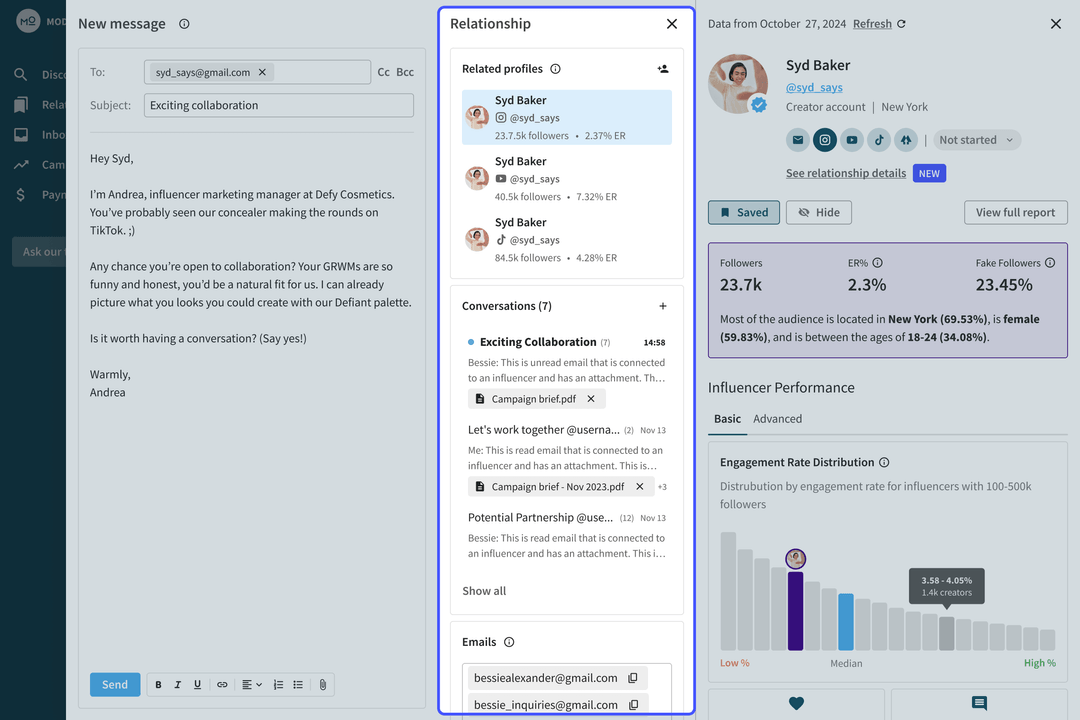

Investing in a tool that can help you manage your Black Friday campaigns (and beyond) from A-Z is the biggest step up you can make this holiday season. Try it for yourself at no cost for 14 days – no credit card needed.
Does all the additional work required during BFCM come at the benefit of a high ROI? 83.9% of marketers align their Black Friday influencer campaigns with other marketing initiatives. And most of them said influencer campaigns performed better than other marketing campaigns. Hear it from Alice:
Last year, during BFCM, our influencer campaigns delivered an ROI of around 12. For comparison, the company’s overall ROI was 5.22, and paid ads generated an ROI of 4.56.
For Lee, the influencer marketing campaign itself had slightly lower ROI than paid campaigns, but the long-term benefit was higher:
Influencers drove strong engagement and delivered a healthy return, especially on top-of-funnel awareness and mid-funnel conversion via unique discount codes.
He shares some tangible results, too:
Overall, our influencer channel achieved around 3–4x ROAS, which was slightly lower than our highest-performing paid ads but provided valuable UGC and extended reach that boosted other channels too.
Influencer content’s ROI extends far beyond the holiday season itself – especially for platforms like YouTube. People view (and get influenced by) a creator’s content long after its publishing date – which means you see intangible brand positioning benefits in the long haul. Abdullah explains:
While paid ads gave us quick traffic spikes, influencer content delivered more engaged audiences and better conversion rates over time especially when creators had built real trust with their followers.
It’s worth remembering that the ROI of influencer marketing is often subtle and invisible (except for affiliate campaigns) – and this doesn’t change during BFCM.
For instance, people might see an influencer post about your brand in September and make a note to purchase something from you in October. But since they don’t come via an influencer’s post directly, this lead/conversion is never attributed to influencer marketing.
Wherever possible, try to use things like UTM links to track and report on your influencer marketing efforts. Ask your customers in post-purchase surveys about where they heard about your brand. All of these things help make the invisible work you do get its fair share of the limelight.
No matter what, Black Friday is gonna be a chaotic time. But there are things you can do to make this time less stressful and more fun.
It’s a mad time, I know. Take it one step at a time – you’re gonna ace it. Go get ‘em.
Our expert contributors