Free virtual event: hear from influencer leaders at ŌURA, Adobe, Stanley 1913 & more.
See the lineup



Things in the influencer marketing world change at whip speed. What worked last year might already be outdated. Something that worked when Instagram’s logo was brown might be making a comeback.
That’s what makes this space exciting and exhausting. Staying ahead means knowing what’s shifting before your competitors do.
So, we dug into the data, spoke with the marketers actually doing the work, and compiled the 10 influencer marketing trends that truly matter right now. Let’s get into it.
There’s no use denying it, influencers regifting your brand’s PR boxes (no matter how beautifully customized) is an undeniable reality. Nearly one in two marketers we surveyed shared they’ve seen a creator regift or resell products from a gifting campaign.
And as painful as it sounds, regifting is not always a bad thing. Maybe the influencer created content for your brand and then resold the product in private to avoid waste. Or perhaps they regifted it to a loved one. For smaller creators, reselling a product is also a way to earn some extra cash to cover their bills.
In all cases, regifting isn’t harming your brand reputation. For example, Nicole Ampo didn’t mind when an influencer regifted her brand’s products to her mom – she appreciated it, in fact:
I actually support [regifting] more since it puts the product to good use instead of it just being forgotten somewhere around the house or thrown away. I remember an influencer who gifted our product to their mom since she loved it. I think that was very thoughtful of the influencer.

But if the creator raves about your products one day and then openly tries to resell them a week after, your brand appears as disposable and your partnership comes across as inauthentic.
You can protect your brand reputation from inappropriate regifting in two ways:
Unfortunately, if you’re doing a no-strings-attached gifting collaboration, there’s not much you can do to prevent regifting except blacklist a creator doing this from future partnerships.
⚠️ Note: it’s crucial you avoid sending products to influencers who haven’t explicitly agreed to receive them. Many influencers – especially mega creators – receive hundreds of parcels every day that they didn’t even approve. To avoid clutter and waste, these creators may openly sell your products, which can harm your company’s image.
More and more brands are now getting actively involved in the content creation process of influencer marketing.
Instead of giving creators some rough guidelines and letting them run with it, marketers are choosing to co-create a detailed brief with creators, align on creative ideas, and create unique, high-performing content.
The primary reason behind this trend is the ever-expanding clutter in social media feeds. Thanks to so much saturation, it’s getting harder for everyone to stand out – whether that’s brands themselves or creators producing content for brands. Co-creating content allows much more room for creativity that instantly grabs attention in busy feeds.
Co-creation also helps creators get more invested because instead of seeing the relationship as a contractor (“we’ll collaborate again if you perform well”), you reframe the relationship as partners (“let’s make this successful so we can do more together”). Instead of transactional, the goal becomes mutual – amplifying your and the creator’s brand.
Co-creation doesn’t mean you’ll throttle an influencer’s creative freedom. Instead, you’ll explicitly focus on doubling down on their creativity and uniqueness for your brand.
MCoBeauty is a great example of how to ace co-creation. They often invest in deep relationships with influencers and co-create content with them.
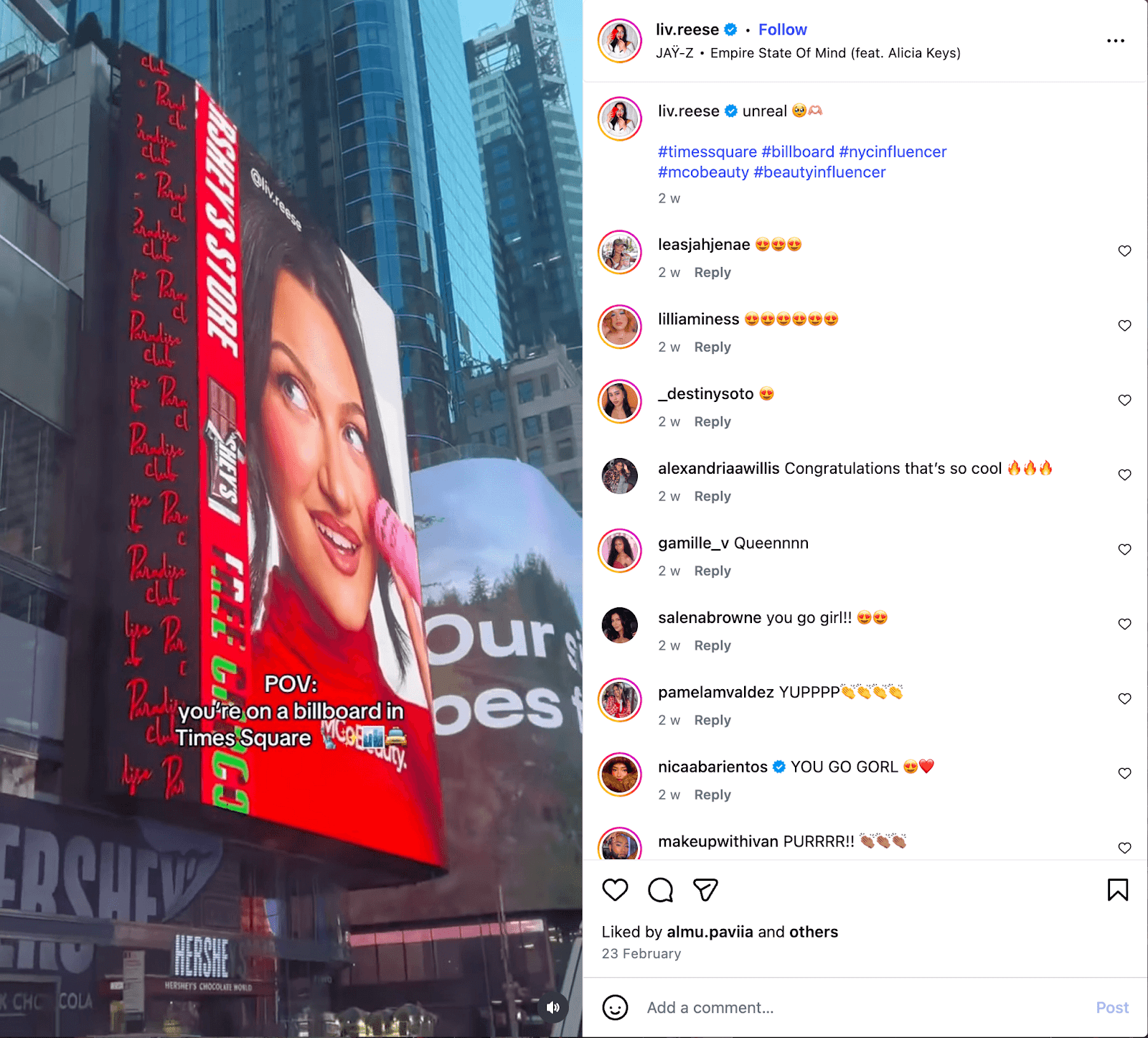
⚠️ Note: not all creators will be the right fit for co-creating content. Because of the time and resources required, it’s best to practice co-creation with influencers who already have a distinct voice and memorable style.
More than half the marketers we surveyed (57.6%) say they’re concerned about market saturation. This feeling is more common in competitive industries like skincare, fashion, and food, but it’s spreading to other niches, too. Market saturation has become an all-too-common scenario – you find perfect brand fit creators, but they’re either:
Two simple solutions are:
a) Collaborate with smaller creators who have a lot of potential
b) Lean on your long-term creator relationships and experiment with different content angles to avoid audience fatigue
While these solutions can definitely help, it’s also worth checking if you’re being too stringent with your ‘ideal influencer’ criteria. It’s not always a lack of creator availability that leads to market saturation – it’s also a long list of non-negotiable requirements.
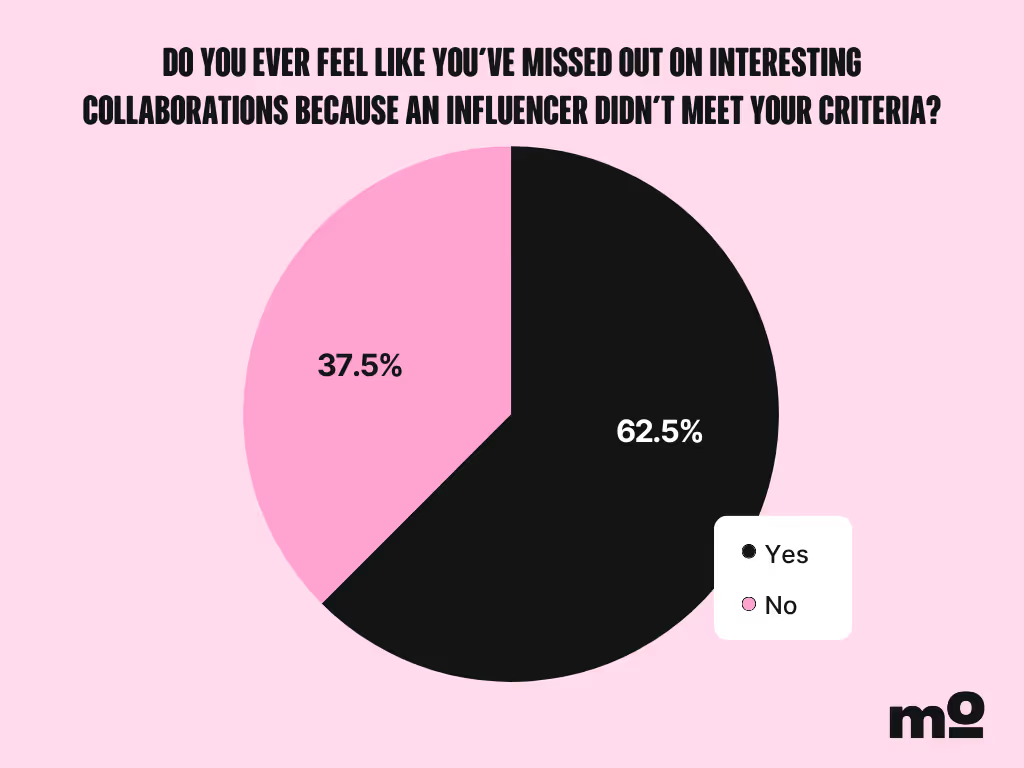
And it has consequences: nearly two-thirds of marketers in our survey shared they’ve missed out on interesting collaborations because an influencer didn’t meet their criteria.
We’re not suggesting discarding your brand fit requirements and partnering with any creator. But be a little more flexible with criteria like aesthetics, follower count, etc., which can’t make or break your campaign.
And instead of always relying on creators in the same niche, look outside the box and find storyfit creators – aka influencers who might not be from the same industry, but whose story aligns with your brand and audience. Kat La Fata even suggests that limiting your partnership to only creators in your own niche can limit your creativity:
Think outside the box. Where can your brand make surprise (but relevant) experiences? Sometimes you’re looking to fill such a specific box that you’re squeezing all creative, authentic juice from it.

👉 Learn more about storyfit influencers – how to find, vet, and partner with them.
If you’re looking to understand which content format will give you the most bang for your buck, the best-performing deliverable (according to our survey) is short-form video content on Instagram and TikTok.
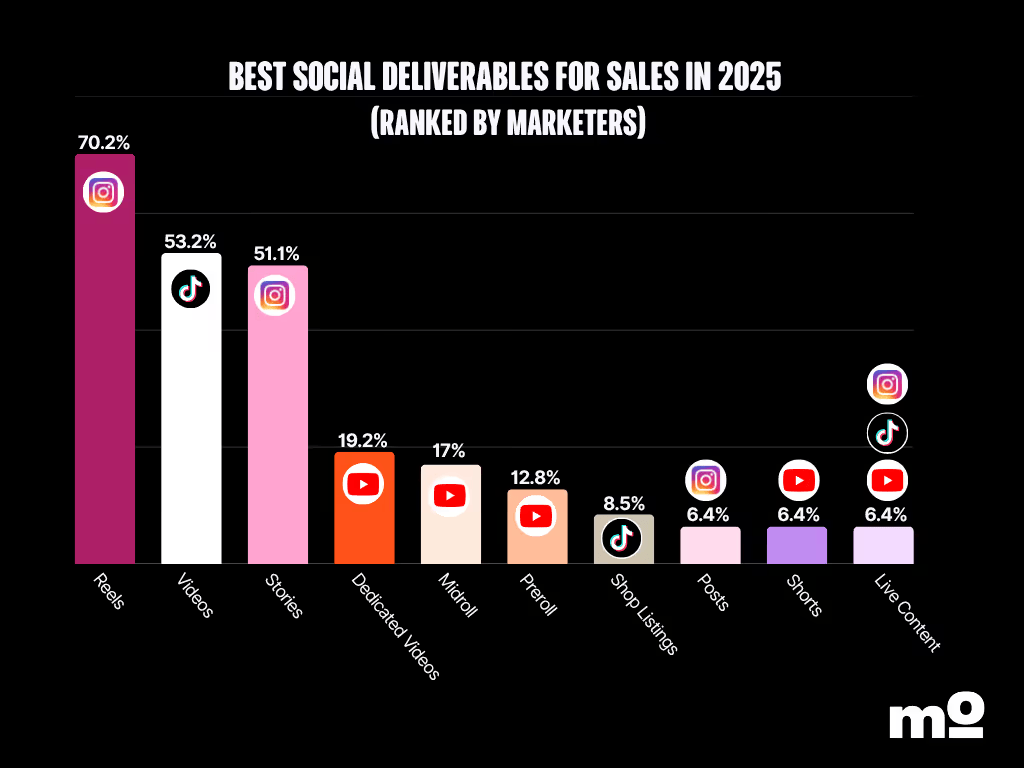
The love for Reels is expected: Instagram has a vast user base (over three million monthly active users!), and Reels are the algorithm’s favorite. Even in our previous surveys, marketers have consistently ranked Instagram Reels as the best-performing content format for sales.
But it’s not just algorithmic favoritism – short-form video matches how people consume content now (fast, sound-on, thumb-stopping). It’s the format that feels native to both platforms, which is why engagement remains high.
TikTok videos beat Instagram Stories in our most recent survey, but not by a high margin. TikTok videos were rated the highest-performing deliverable by 53.2% of marketers and IG Stories by 51.1%.
The best part is that all three formats – Reels, TikTok videos, and Stories – perform just as well for brand awareness as they do for sales. They’re also pretty flexible. Whether you’re experimenting with creators outside your niche or trying a new type of collaboration, short-form video adapts to pretty much anything.
And you don’t need high production value to make them work – lo-fi, authentic-feeling content tends to perform just as well (if not better) on both Reels and TikTok.
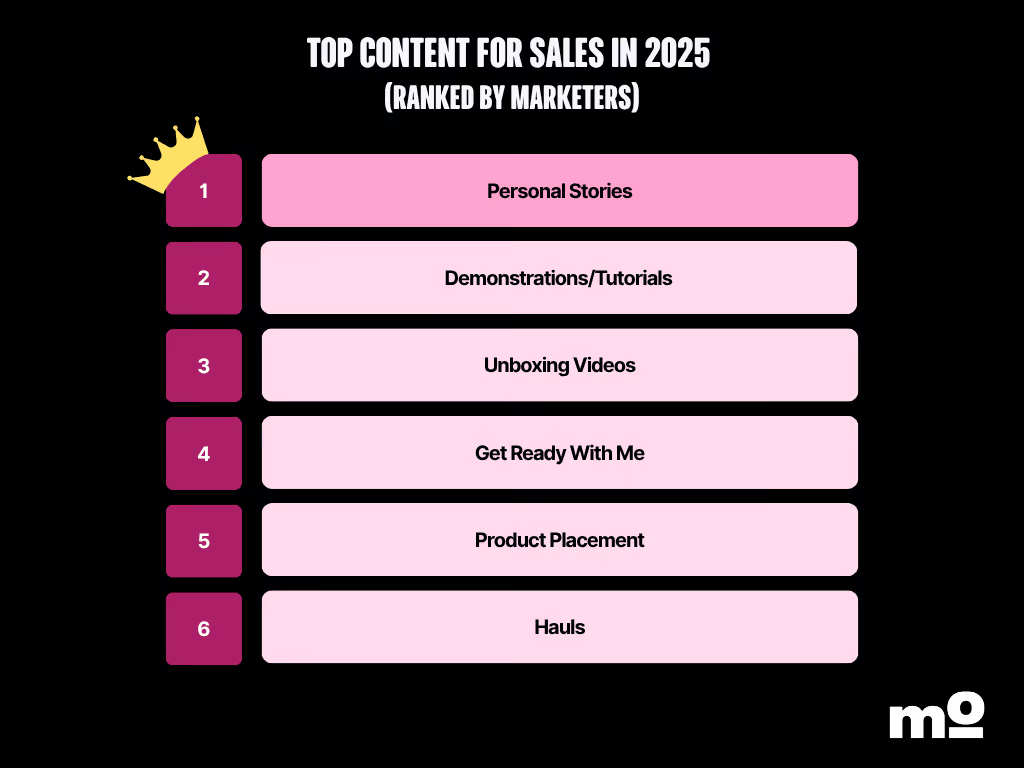
Zooming in a little bit on the content formats, personal stories as a content type give the best results for influencer campaigns for both conversion and brand awareness campaigns.
Given how crowded social media feeds feel these days, this isn’t surprising. Personal stories have a way of instantly grabbing attention, holding it, and being memorable long after a video or post is done. Something personal doesn’t feel salesy and instantly builds a connection. Fiorella Picado says the conventional ad format is on its way out anyway:
The traditional ad-like content needs to go. People already know how it works, so brands need to be more clever about how they present their products and infuse value into the content, not just broadcast the product.

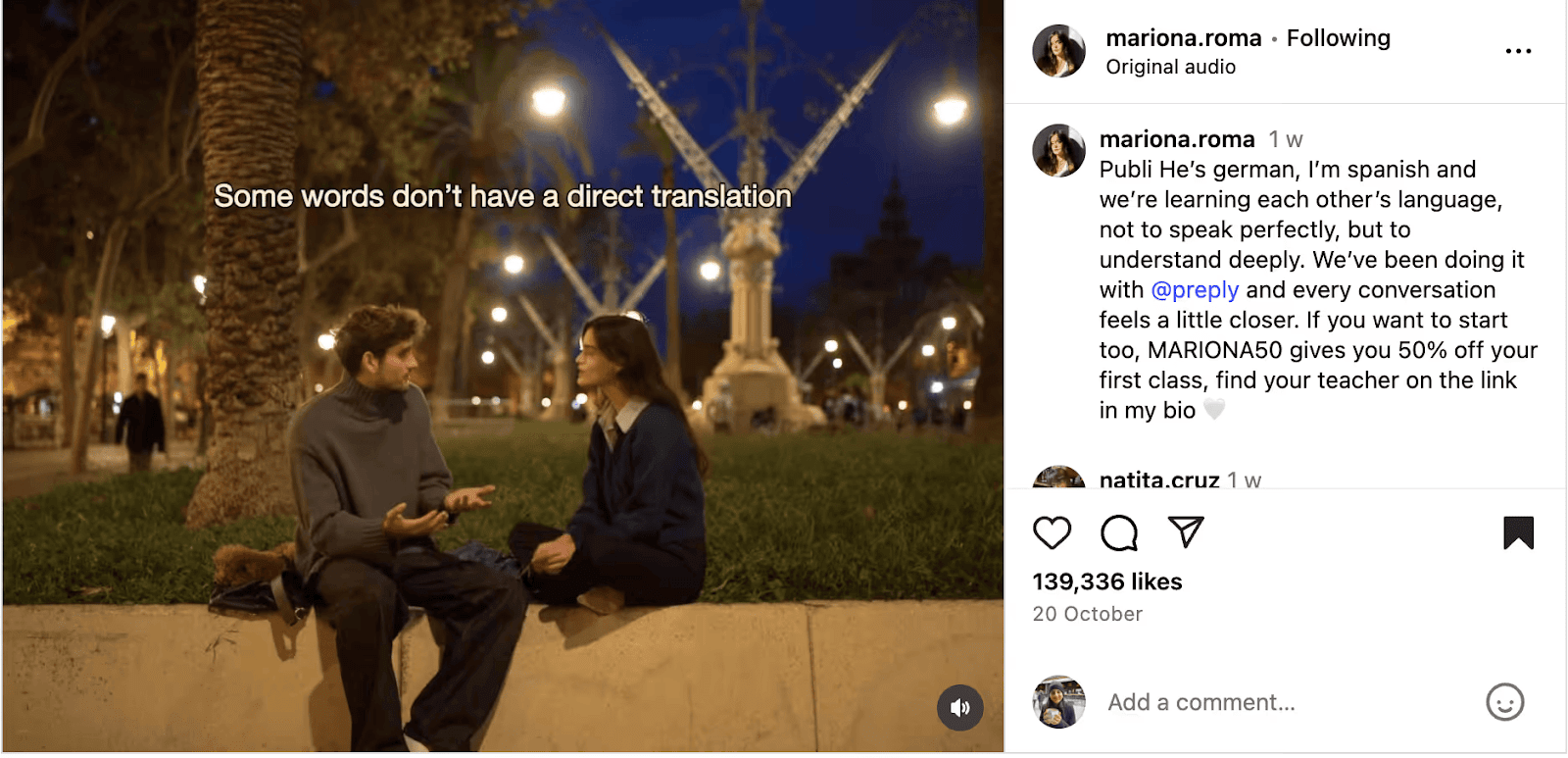
Mariona’s partnership with Preply is the perfect example. The creator showcases how she’s using the tool to learn her partner’s native language because some things don’t have a direct translation. The concept is personal and unique. Plus, the video is extra memorable, showing us a few of the un-translatable words.
After personal stories, product tutorials are the most impactful for conversion-oriented campaigns. This makes sense – product tutorials are inherently bottom-of-the-funnel content. Someone seeing this type of content is likely a warm lead already and is doing final checks before buying.
For brand awareness campaigns, ‘get ready with me’ content takes the second spot. It’s easy to integrate your product into this already-proven, successful format. Someone who has begun watching this type of content will likely watch till the end to see the final result.
The takeaway: it’s best to put your top focus on personal stories for both brand awareness and sales campaigns (storyfit creators will be a natural here!). Beyond that, focus on GRWM videos for brand awareness and product tutorials/bottom of funnel content for sales campaigns.
The era of mega creators posting basic content and brands seeing wild success is long over. Today, larger creators are much more expensive and offer a much lower engagement rate. They’re extremely high risk for most SMBs.
Plus, audiences are more trusting of smaller, niche, relatable creators over larger ones. Lee Drysdale elaborates:
The average consumer is becoming savvier to what’s a cash grab and what’s an authentic partnership. Whilst mega influencers and celebrities hold a lot of power to actually influence, the niche talent has built a community on trust!
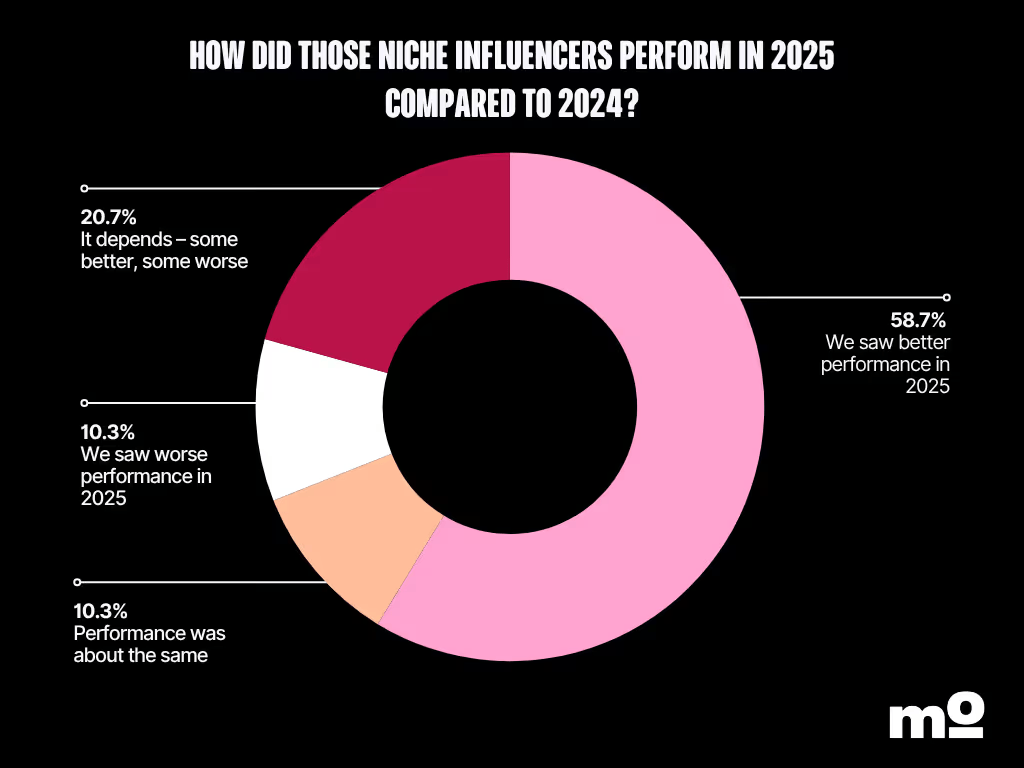
Marketers are seeing this on the ground: nearly 60% of those we surveyed said niche influencers performed better in 2025 compared to 2024.
And this shift isn’t slowing down. Niche creators have built real trust in their communities, charge less, and give you more room to experiment. Win, win, win all along.
The only caveat to remember: when you start scaling with many micro-creators, you’ll have a lot on your plate to manage – namely, contracts, feedback rounds, briefs, payments, and a lot more. Good thing AI can help you with many of the tedious tasks now.
An influencer marketer’s job involves a lot of logistical and admin load:
AI’s addition to the workflow can reduce the burden of many of these tasks. Over half the marketers we surveyed already use artificial intelligence for tasks like influencer search, recruitment, and relationship management – and will continue to do so.
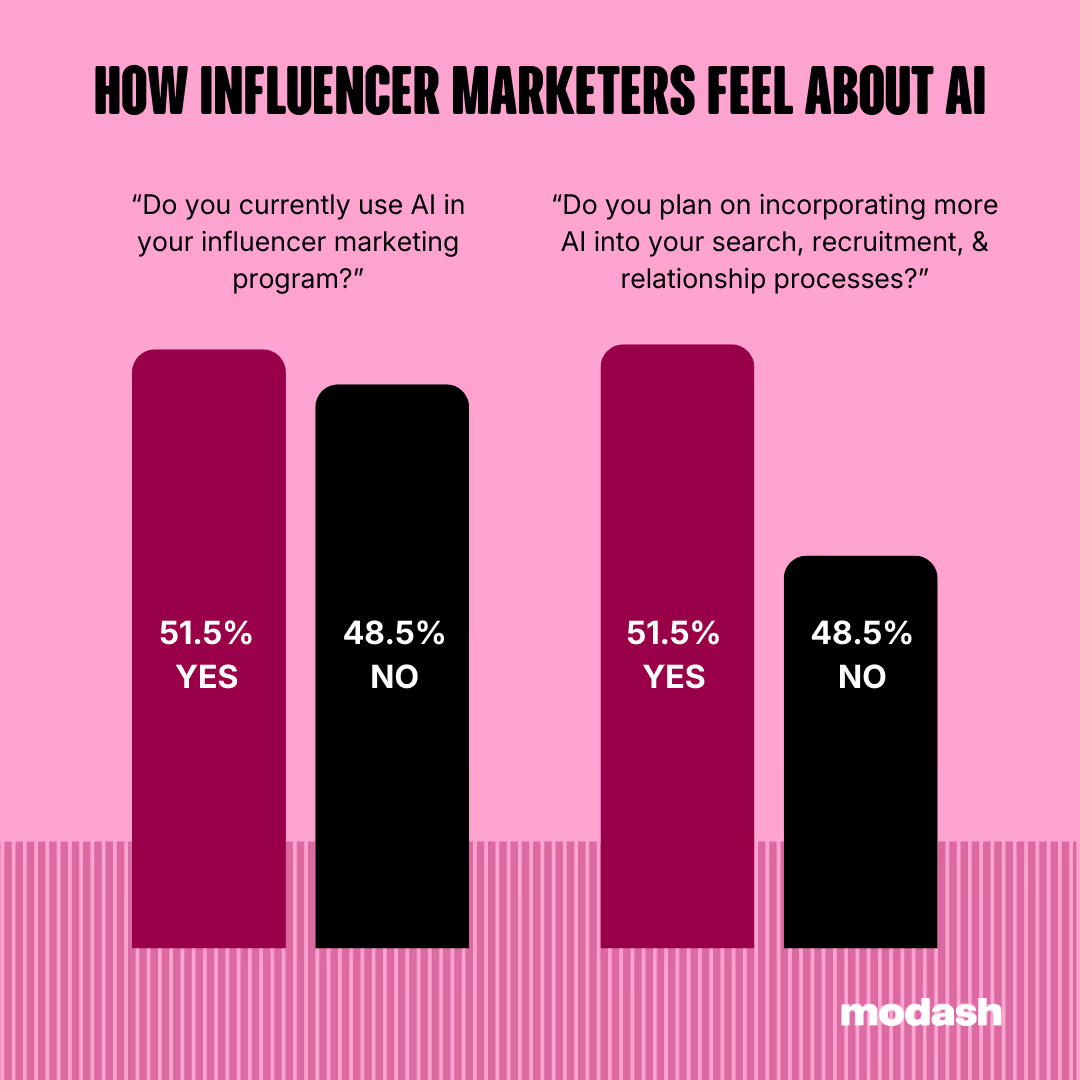
AI can handle a lot of the recurring work – faster and with fewer mistakes. The most popular desire amongst marketers seems to be for AI in influencer discovery: 73.7% of marketers say they wish they could use AI for this task.
And it makes sense: finding relevant influencers can be a huge time suck. Thanks to AI-powered influencer search tools like Modash, you can actually use semantic or visual search to find ultra-relevant creators. Layer filters on top to be even more specific.
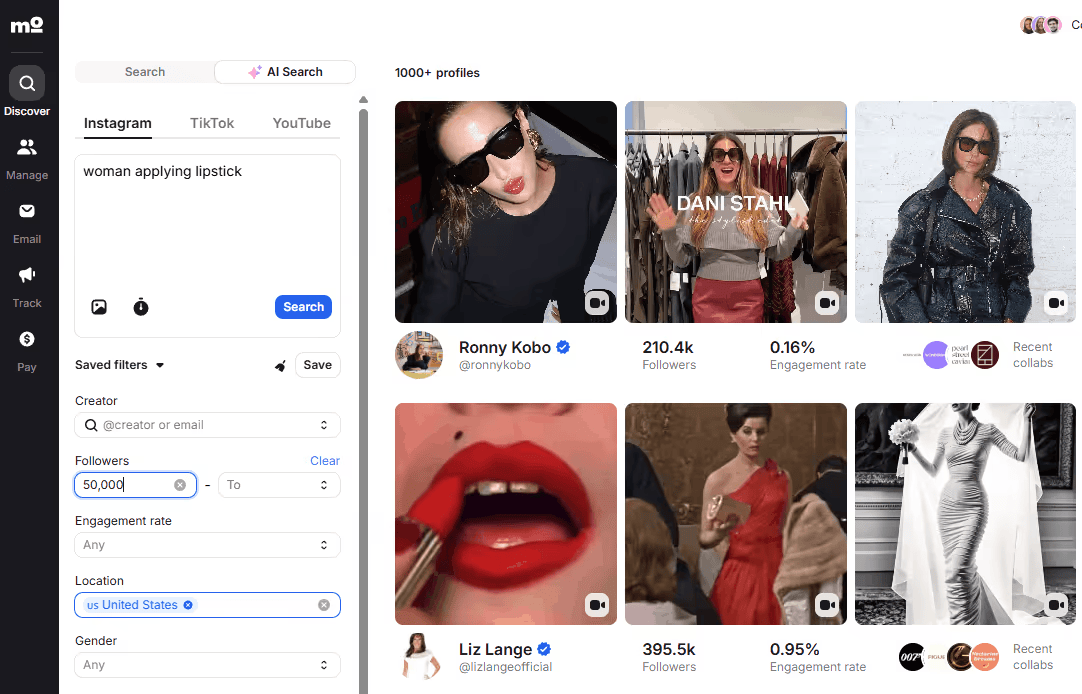
Apart from that, you can also use AI to:
The tricky bit, though, is strong creator relationships are the foundation of successful influencer marketing. And you can’t automate personal touch using artificial intelligence. It’s critical to strike a balance where you use AI to move faster for your tedious tasks without sacrificing your influencer relationships. Anna Jędrzejewska says it best:
AI won’t replace the human touch (good luck automating intuition), but it will give us back the hours we need to actually strategize instead of chasing file links and signatures. Influencer marketing is evolving from spreadsheets to systems.

Here’s a quick cheat sheet on what to use vs. what to avoid AI for:
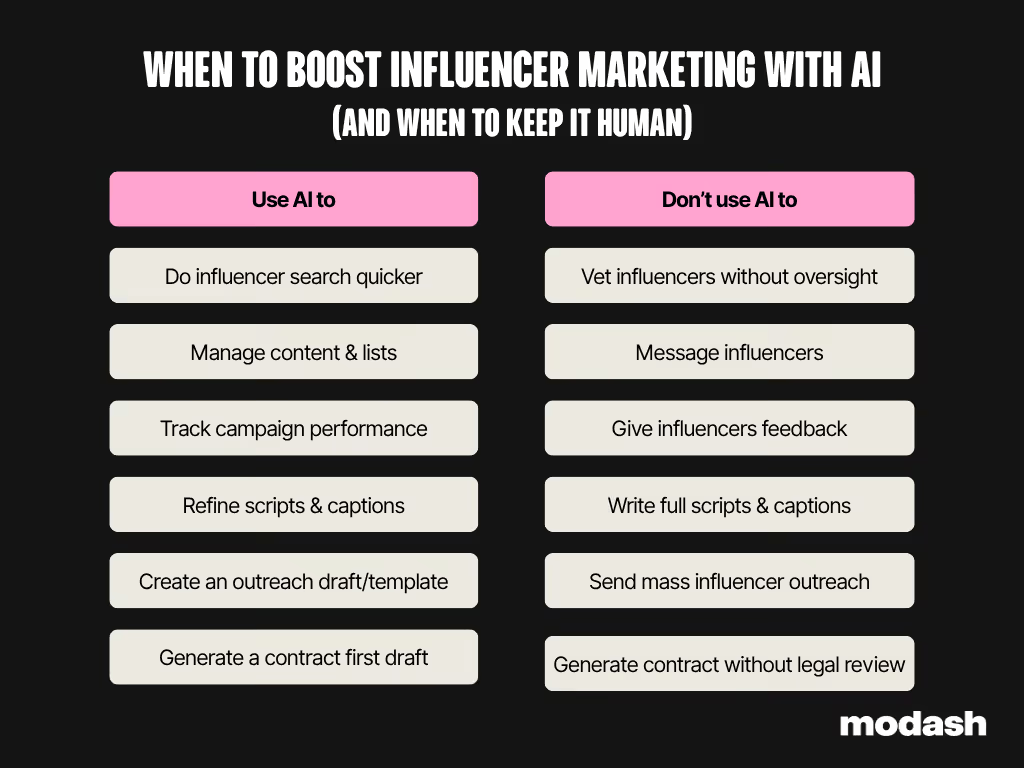
👉 Learn more about how influencer marketers are using AI.
Influencer marketing and affiliate marketing used to be treated as separate disciplines. But today, affiliate marketing is becoming a subset of creator marketing. Over half of the marketers we surveyed said they invested more in their affiliate program in 2025 than they did in 2024.
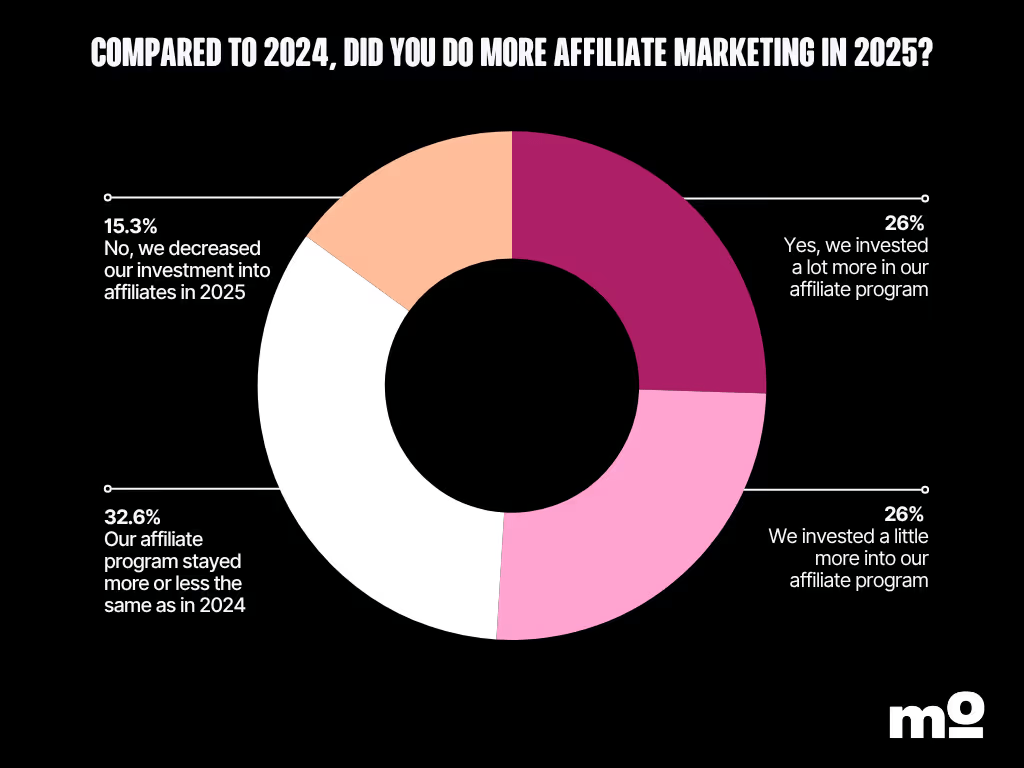
Part of the reason for this rise is affiliate marketing is more secure than sponsored posts. You pay a creator based on the number of sales they bring in – making it easier and safer to prove a campaign’s impact. Affiliate campaigns are also much simpler to track, which means you can quickly identify which influencers are creating the biggest impact.
In 2026, this trend will continue rising. Marketers will use various kinds of collaborations, including affiliate marketing. But how are creators taking this news?
According to our survey, influencers are less willing to become affiliate partners compared to previous years. In 2024, more than 63% of marketers said influencers were open to becoming affiliates. In 2025, that number dropped to 26%.
And more tellingly, over 45% of marketers say influencers are less open to becoming affiliates than they were a year ago.
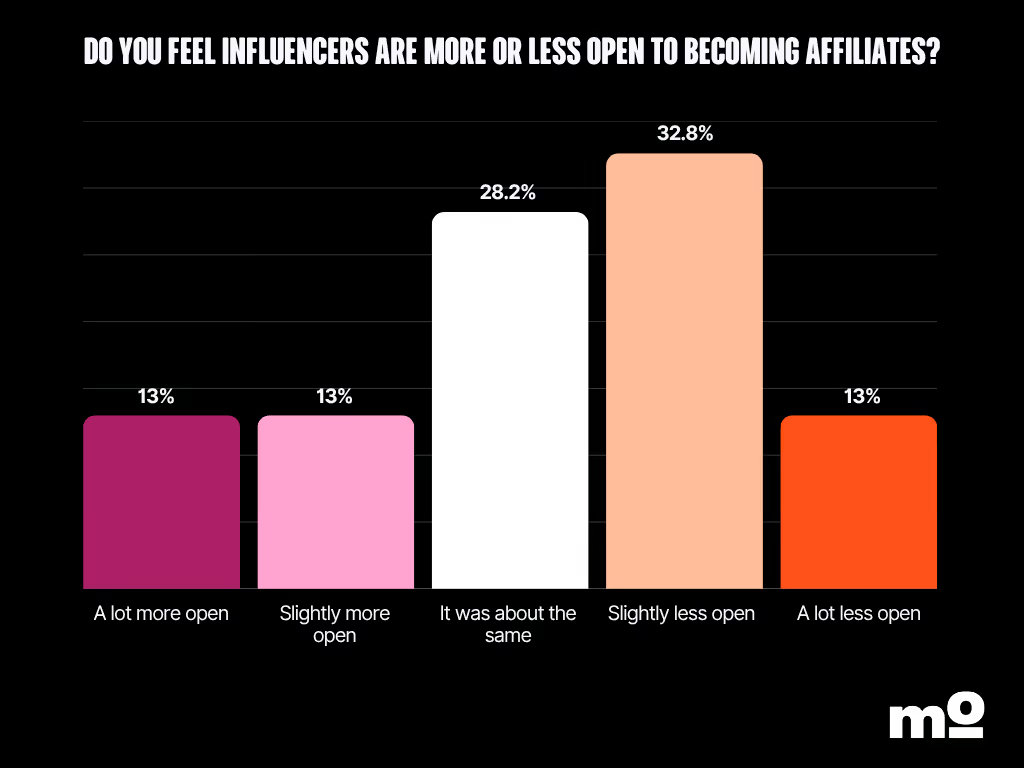
But there’s a nuance here: influencers aren’t unwilling to become affiliates. They’re just careful about performance-based compensation models. If a creator is only getting paid when someone buys something off their link or post, their income becomes precarious.
Not to mention, a creator’s performance is affected by many external factors like the algorithm, brand website, and other discounts on your site. All of these factors are beyond a creator’s control.
The middle ground is brands offering a flat fee and layering performance-based compensation on top. Creators get some level of security and you don’t overpay unless an influencer performs exceptionally well. The hybrid payment model gives you the best of both worlds. Leslie Belen agrees:
The single biggest trend will be the total migration toward performance-based deals. Every brand is under so much pressure to prove ROI that in 2026, we'll pivot almost entirely to small-retainer-plus-high-commission structures, signaling the end of the flat-fee model's dominance.

Data backs this up, too: over 23% of marketers shared influencers were open to performance-based compensation in 2025, but only when a flat fee was provided upfront.
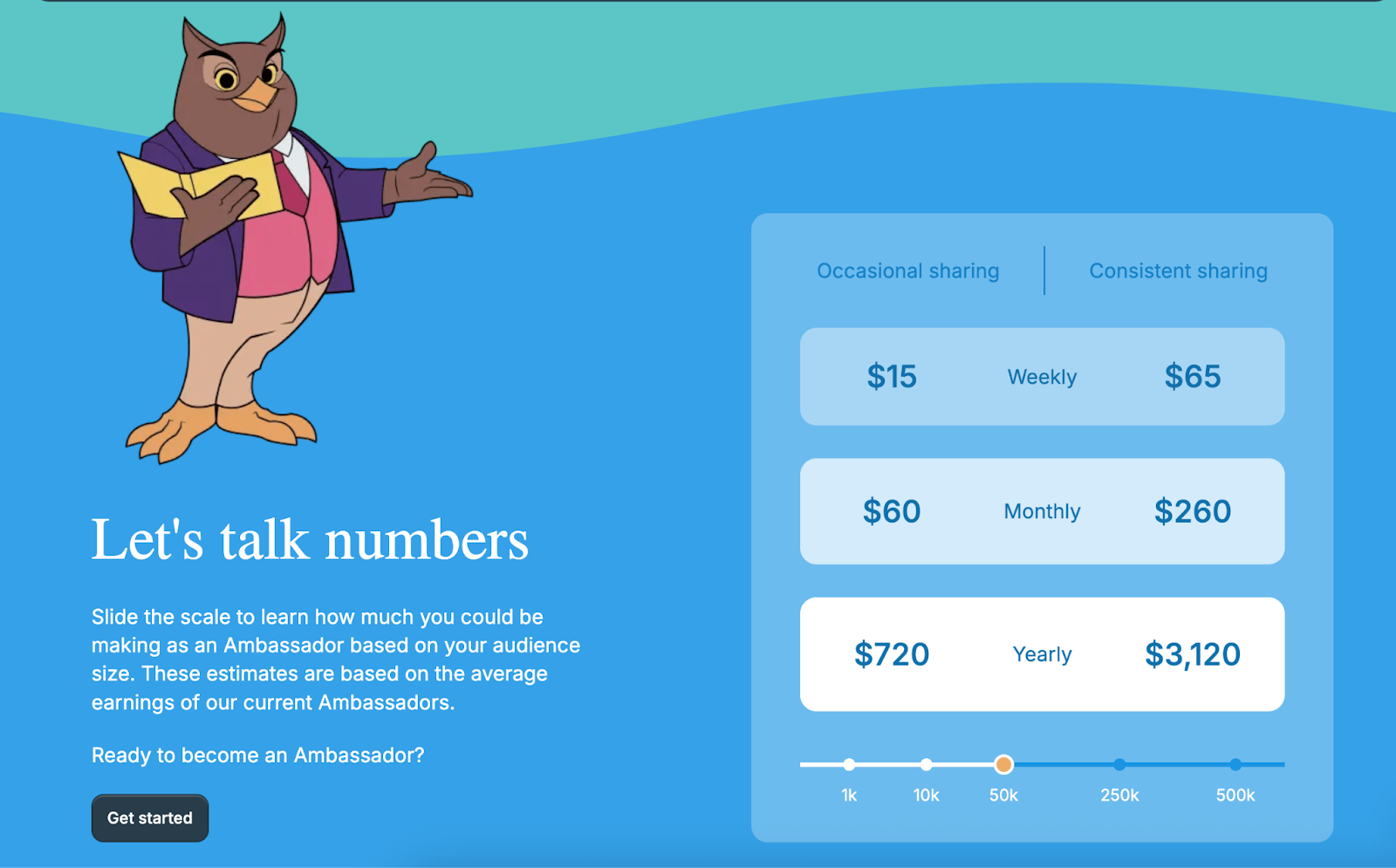
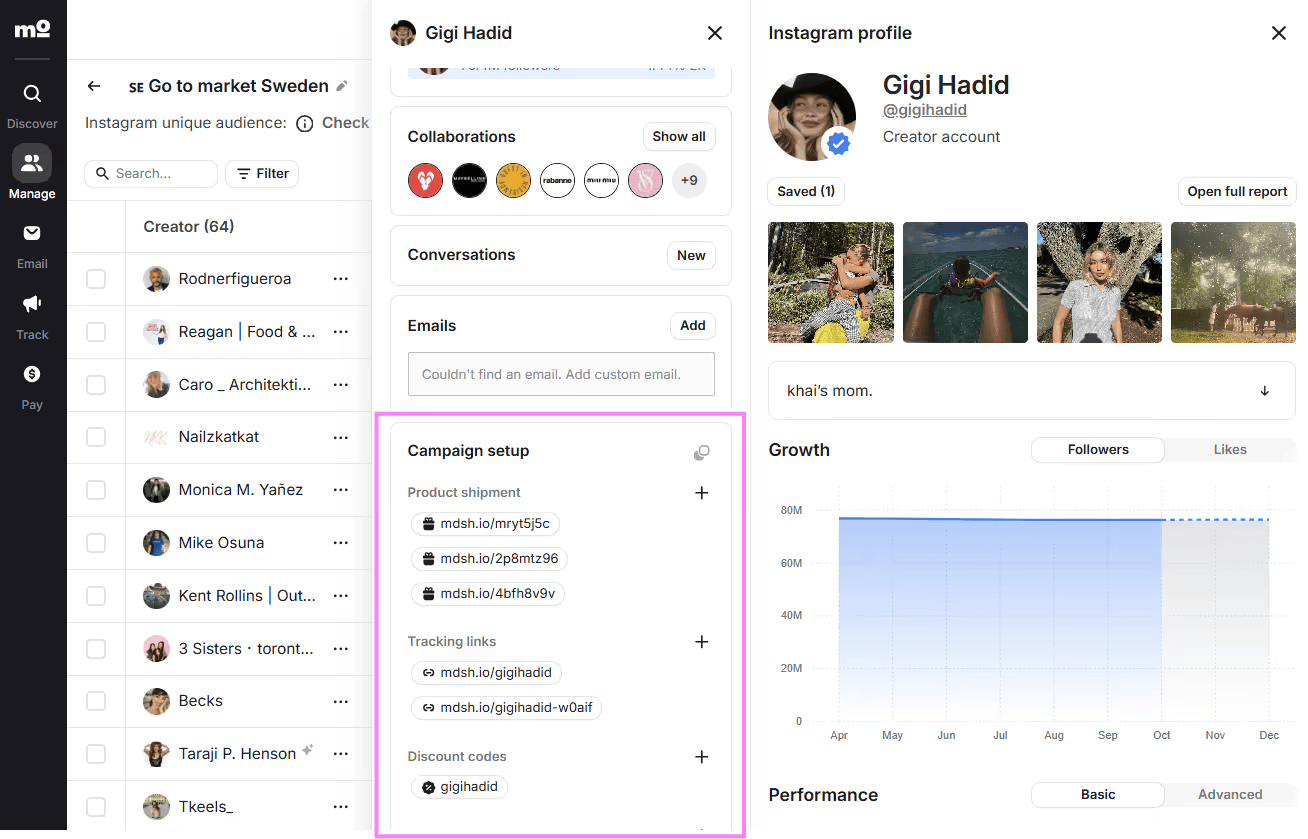
If you sense hesitancy among creators while proposing a performance-based compensation model, try these negotiation tactics:
👉 Dive deeper into how you can build a successful affiliate program.
Marketers are getting more cautious about long-term influencer relationships. In 2024, 75% of our respondents ran more long-term partnerships than they did in 2023. Over 84% even said they had planned to double down on them in 2025.
But in reality, just over half of the marketers we surveyed (54%) ran more long-term collaborations last year.
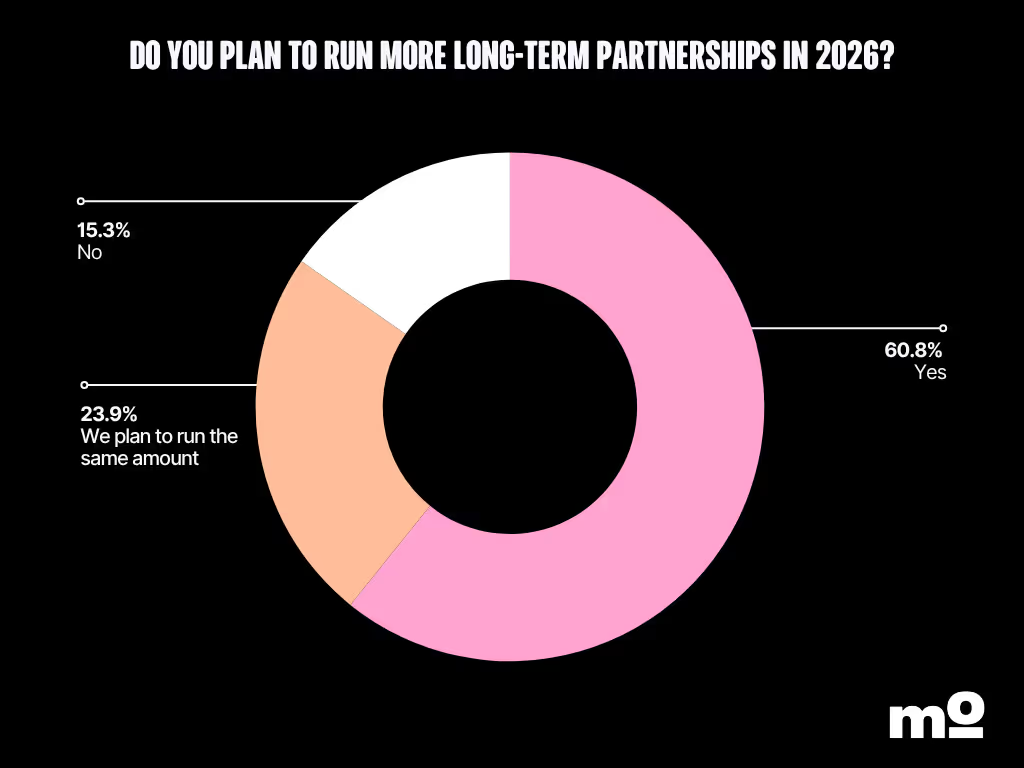
This was for good reason: 2025 felt more uncertain than anyone expected, so it was wiser to invest in short-term collaborations. But the tide is slowly turning again. Over 60% of marketers also say they’re hoping to invest more in long-term campaigns next year.
Long-term collaborations build trust and authenticity in a way that short-term partnerships can’t:
Long-term partnerships are an effort that keeps compounding. But if you want to minimize the risk, here are two tips:
Long-term partnerships can be the ultimate gateway to build trust, gather honest feedback, and experiment with your wildest ideas. They just have to be done right and balanced with short-term collabs to reduce the risk and dependency.
There’ll always be a few creators who don’t meet their promises. Some stories we’ve heard are:
Unfortunately, there’s not much you can do after a creator has already done any of the above. Tools like Modash can help you flag when an influencer has failed to disclose an ad properly. But most of the legwork has to be done before you even hire the creator:
The smartest thing you can do is budget for these issues. Leave some wiggle room for when things go sideways – because at some point, they will.
The through-line across all ten trends is pretty clear: influencer marketing is getting more strategic and less transactional. The brands seeing the best results are the ones investing in real creator relationships, leaning into personal content, using AI for the admin stuff, and building flexibility into their budgets and criteria.
But knowing the trends is only half the battle. The other half is actually executing on them – finding the right niche creators, tracking affiliate performance, monitoring whether influencers are disclosing ads properly, and managing long-term partnerships without drowning in spreadsheets.
Executing on these trends is easier with the right tools. That’s where Modash comes in. You can search through 350M+ creator profiles using AI-powered search, track content and performance automatically, and manage your entire influencer program in one place. Try it free for 14 days – no credit card required.